
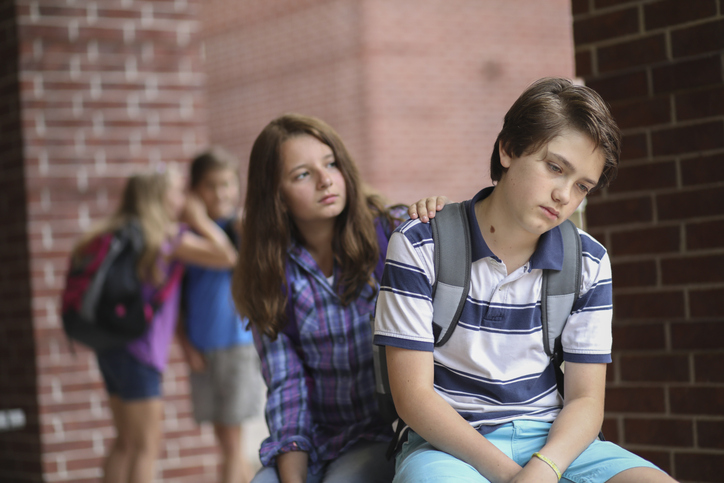
Did you know that each year, 1 in 5 kids get bullied and that 57% of the bullying incidents stop when a peer intervenes on behalf of the victim? That means that the observer’s reaction, big or small, influences what happens next, shifting the focus from “why does the bully act this way?” to “why does the crowd allow it to happen?”
Bullying thrives on an audience
To understand why bystanders stay silent rather than assist the victim, we have to understand how typical bullying unfolds. Bullying is often perceived as a dynamic between the aggressor (or the bully) and the victim (or the target). The reality is far more complex. Finnish psychologist Dr. Christina Salmivalli found that bullying is not just an altercation between two kids, but rather a social performance. It often occurs in packs or groups.
The bully is not only after the victim but is also seeking power, elevated social status, attention, and approval. Small signals from the crowd enable the bully, such as people laughing, recording, or joining the action.
When the crowd reinforces a bully’s behavior, incidents become more frequent. However, when bystanders take the victim’s side, the bully’s social status is threatened, and the bullying may cease.
Why do well-meaning bystanders stay quiet?
Often, bystanders refuse to speak up or assist because they fear becoming the next target or being judged or ridiculed. Others feel unsure of what to say, worry that involving adults will make things worse, or simply freeze in the moment. Standing out, calling attention to oneself, and breaking from group consensus run counter to the adolescent social calibration. Studies show that when bullying occurs at school, bystanders often don’t believe teachers will handle the situation effectively, and that fear feeds inaction.
Bullying is a research specialty of Dorothy Espelage, a professor at the UNC School of Education. Much of her work is peer-led and focuses on training students to guide others by modeling upstander behavior. She led a study of more than 346 middle-schoolers that showed that boys are less likely than girls to intervene in a bullying situation, especially if the boy is part of a group where bullying is considered the norm.
“It appears that until you reduce bullying within certain peer groups, some kids are unlikely to intervene,” Dr. Espelage says. “Just telling kids to intervene doesn’t recognize that some of the bystanders are entrenched in peer groups where bullying is just their repertoire.”
Types of bystanders
In a bullying situation, the crowd naturally falls into four different roles:
- Outsiders – who assume it is none of their business and stay out
- Defenders – who speak up against the injustice they are seeing
- Reinforcers – who support the bully and reinforce the behavior
- Assistants – who join in bullying the victim
In a bullying scenario, bystanders may assume different roles as the incident progresses. When the bystander is a close friend of the bully, they may oscillate between becoming a defender or an outsider, fearing they may lose the bully’s friendship. In some cases, they may feel forced to become reinforcers or assistants to please their bully friend.
How bystanders can become upstanders
There are many things a bystander can do to diffuse the situation and help the victim. Below are a few practical suggestions:
- Speak directly to the bully when it’s safe: A simple, non-confrontational statement like “stop, that’s not nice or cool,” from even a single person, can disrupt the bully’s momentum and social spell.
- Distract and redirect: change the subject or focus to break the episode’s momentum and give the victim a chance to exit. Simple things like creating a physical reason to move away or starting a new conversation can be very effective.
- Include the person being excluded: At times, the most powerful act is to make the victim feel included and not alone, rather than confronting the bully.
- Check in later: Meet with the victim post-incident, individually or in a group, to offer comfort and support.
- Inform someone: Children should be taught the difference between reporting and tattling. Report the incident to a trusted adult or a higher authority to support the victim when direct action is unsafe.
- Don’t share hurtful messages: Not sharing, liking, or forwarding humiliating or hurtful images or posts online is an act of resistance. Report cyberbullying to a trusted authority before it gets out of hand.
For more tips, visit Bystander Revolution, a website with a crowdsourced list of actions bystanders can take.
Dr. Espelage stresses the importance of educators’ roles in influencing conscientious bystanders. “It comes down to relationships,” Dr. Espelage points out. “If you have strong relationships among students and peers and between students and the administrators and between students and the teachers, you have less bullying.”
An upstander has more power than anyone else to move the needle in the victim’s favor. They can also become role models for others when they speak out, inspiring those who remain silent. It takes many voices to get a movement going. Become an outstanding upstander and change the tone!
Contributed by Saumin Mistry, 10th grade


